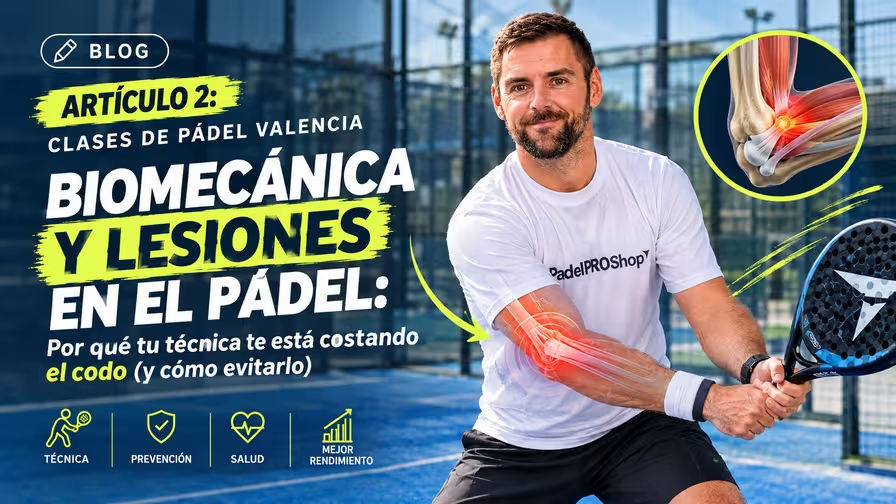
Padel has experienced a spectacular boom, but this growth has been accompanied by a silent epidemic. According to the latest epidemiological studies in sports medicine, tendon injuries in the arm account for more than 40% of all pathologies in this sport.
Hi there, I'm Manu. As a Sports Science Graduate (CAFYD), in our padel lessons in Valencia and Paterna we see players every day arriving on court dragging elbow pain —whether lateral epicondylitis ("tennis elbow") or medial epitrochleitis ("golfer's elbow")— assuming that wearing a strap or taking anti-inflammatories is simply "the price to pay" for playing. Through biomechanics and sports science, let's break down why this is false and how to solve it for good.
The Equipment Trap: Racket & Vibrations
Unlike tennis, where strings dissipate a large portion of the impact energy, a padel racket is solid, has a shorter handle, and features a very different center of mass. Scientific research has proven that several equipment factors drastically multiply the eccentric stress endured by your forearm tendons to stabilize the racket at the moment of impact:
- Diamond-shaped rackets: They shift the balance toward the head of the racket, increasing the torque your wrist must accelerate and brake.
- Excessive weight: Playing with rackets heavier than 350–365 grams without adequate forearm strength.
- Inadequate grip thickness or hold: As we analyzed in our article on the invisible mistakes of the continental grip, a faulty hold forces you to squeeze the handle with excessive isometric tension.
Whenever you hit the ball outside the "sweet spot", the racket transmits severe torsional vibrations that generate continuous micro-tears right at the tendon insertion in the elbow.
The #1 Technical Mistake: Late Impact and "Arming" the Ball
The true root cause of the injury, beyond the racket itself, is the player's biomechanics. The court environment (glass walls, metal mesh) forces rapid spatial adjustments. The most destructive mistake we correct in our padel classes in Valencia is hitting the ball late, especially after wall rebounds.
"When you strike the ball behind your body line, you completely shut down the kinetic chain, forcing the small flexor and extensor muscles of the wrist to absorb the entire load of accelerating and braking the racket." — Manu Carrilero, Sports Science Graduate
The kinetic chain is the sequential transfer of force that starts in the legs pushing against the ground, travels through hip and trunk rotation, passes through the shoulder, and ends in the racket. By preparing late and hitting behind your body, you cut off that transfer and force your wrist muscles to snap at the ball on their own. This mechanical overload exceeds the tissue's tolerance threshold, triggering tendon degeneration.
Similarly, as explained in our guide on why traditional padel technique is holding you back, poorly executed overhead shots like the víbora —where the player abuses lateral slice by isolating the arm without rotating the torso— impose massive valgus traction that destroys the inner side of the elbow (medial epitrochleitis).
Carlos's Case: Relearning How to Play Pain-Free
Carlos is a textbook example of this cycle. He had to quit the courts due to severe acute epicondylitis. When we analyzed his game on video at our indoor court in Elite 22 (Paterna), the clinical origin was unmistakable: late racket preparation at the back of the court and víboras executed purely "with the arm".
In our lessons, we reset his biomechanics step by step:
- We adjusted his grip thickness and corrected his grip pressure.
- We advised switching to a round-shaped racket (low balance) with better vibration absorption.
- Using video analysis and our professional ball machine, we taught him to always strike the ball in front of his body, using leg drive and shoulder rotation to take the dirty work away from his elbow.
When Pain Is Chronic: Technique + Physical Rehab (HSR)
Let's be crystal clear: correcting your technique is the only real long-term prevention, but if the tendon is already damaged and you have chronic pain, padel lessons alone do not heal the tissue. A degenerated tendon needs specific mechanical loading to regenerate collagen.
To achieve full recovery, Carlos combined our on-court technical sessions with a strength and mechanotransduction program (Heavy Slow Resistance - HSR protocol). If you are currently suffering from elbow pain, we strongly recommend visiting our strength & conditioning platform at Tu Entrenador to follow the evidence-based physical rehabilitation for padel elbow. Technique on the court and strength in the gym are the scientific combination to play pain-free!
View physical rehab protocol at TuEntrenador.meMain Scientific References
- García-Fernández P, et al. (2019). Epidemiology of injuries in professional and amateur padel players. (Study highlighting the alarming 40–90% injury prevalence and the direct impact of racket weight and shape).
- Kibler WB (1995). Biomechanical analysis of the kinetic chain in tennis. (Directly applicable to padel; demonstrates how a lack of leg and trunk rotation transfers destructive forces to distal joints like the elbow).
- Sánchez-Alcaraz BJ, et al. (2020). Analysis of padel racket parameters and upper limb biomechanics. (Analyzes how torsional vibrations from off-center hits damage the tendon's collagen matrix).