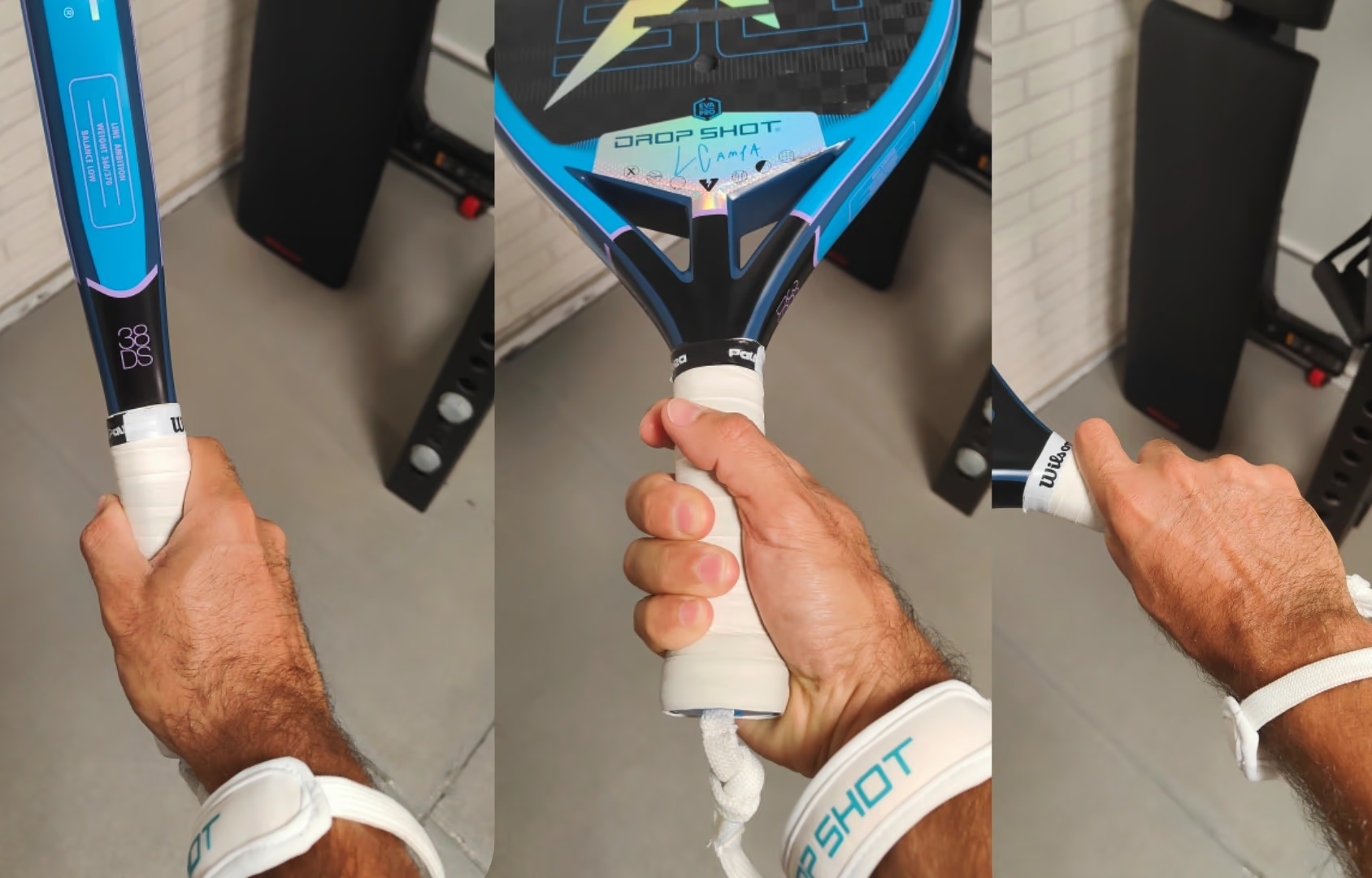
Hi, I'm Manu. When I'm competing on the backhand side, squeezing the most out of my racket and giving the exact power to the ball depends 100% on a millimeter detail: how I place my hand.
The grip is one of the first things I look at when I start giving padel classes in Valencia to a new student. It's a detail that seems harmless, but it dictates your entire game. If you've been playing with friends for years, have spent a fortune on rackets, and feel completely stuck at an intermediate level, I assure you the problem is not your gear. The problem, almost certainly, is in your hand.
"The way you hold the racket conditions the way you hit the ball." — Manu Carrilero
The blank canvas vs. Acquired bad habits
The other day something great happened with a new student. She had only played padel four times in her life and came to take classes. For me, as a coach, that is the perfect scenario. We start from scratch, there are no acquired bad habits, and all I have to do is establish the foundational pillars so she can start flying on the court.
However, she brought one of the most typical mistakes of beginners: she held the racket very high, almost choking it, as if it were a table tennis paddle. I find other students sticking their index finger through the racket's heart (a brutal danger for hand tendons) or with the racket turned almost 90 degrees, imitating a western tennis grip.
The moment I notice weird shots on the court, I look at the hand and there is the culprit.
The continental grip: Your life insurance
To solve this, we always return to the origin.
"Let's say that in padel the base grip is the continental, which is as if we were holding a hammer with the racket to hit a nail with the frame." — Manu Carrilero
Although at more advanced levels we do play with small changes (switching to eastern forehand or backhand grips to boost topspin smashes or adjust volleys), 90% of your amateur game must be built on the continental grip. It allows you to defend, attack, hit wall exits, and volley without losing fractions of a second changing the position of your hand.
Why is it so hard to change the grip if you already have a good level?
This is where the drama of the "stagnant player" comes in. I'll give you my father-in-law's example. He has been playing padel all his life and has always done so with the grip slightly turned, in what would be an "eastern backhand".
Of course, that conditions all his shots. Right now, it would be torture for him to change that motion. In fact, he already tried once with another coach and gave up. Why?
"Because it forces you to change all your technique, all your positioning, and everything you had been doing, since the racket is no longer in the position it used to be." — Manu Carrilero
That is the price to pay. Modifying a wrong grip implies taking two steps back to take ten steps forward. At first, you will miss balls you used to make, you will feel you have no power, and you will get frustrated. But if you don't cross that "desert", you will be limited forever (and besides, you will be buying many tickets to suffer epicondylitis or shoulder pain from forcing the joint in unnatural angles).