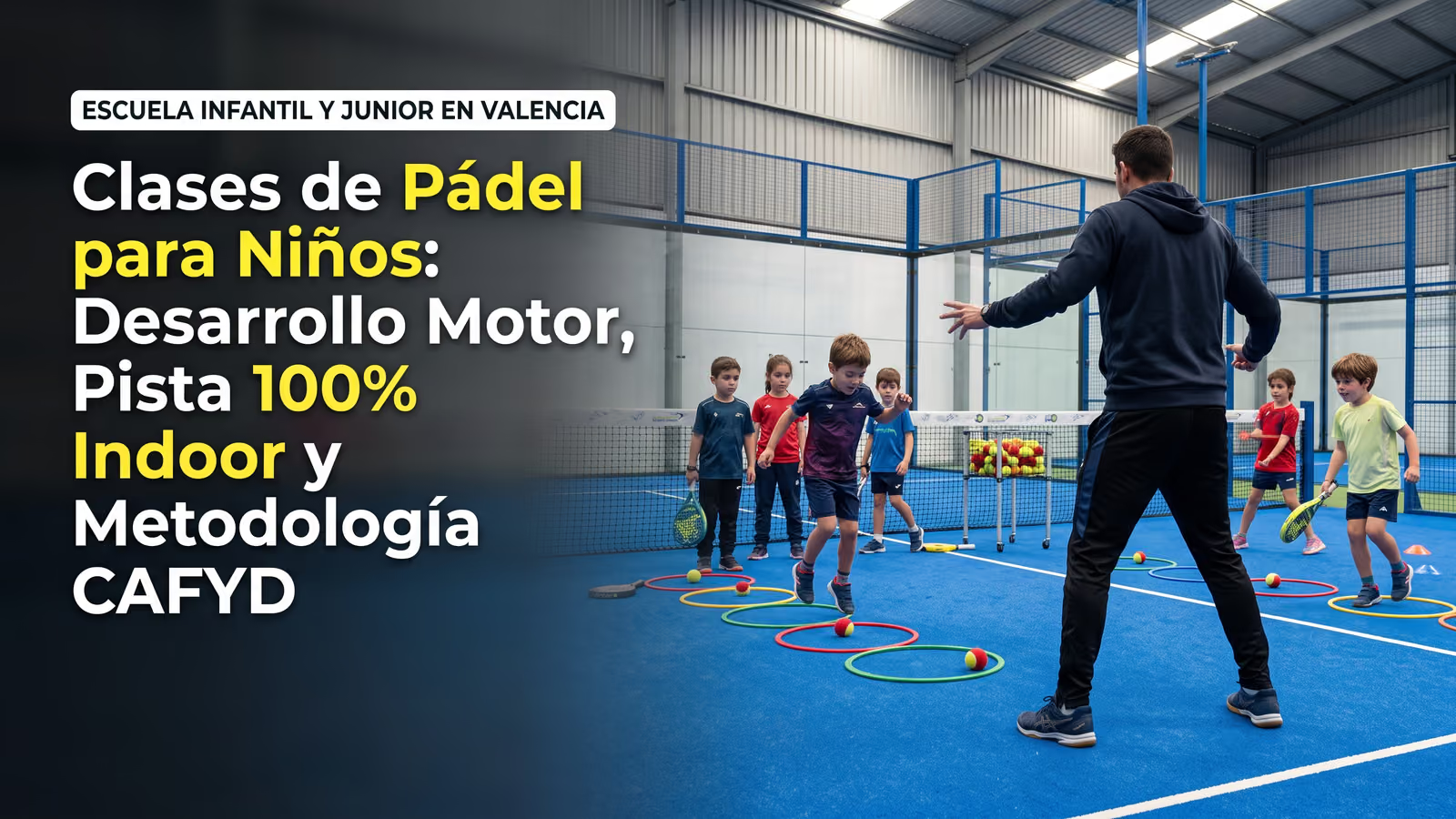
When a parent looks for padel lessons for kids in Valencia (or around Paterna, La Cañada, La Eliana, Bétera, Godella or Burjassot), they usually run into two equally harmful extremes: "paddle babysitting" where 8 kids queue up waiting for the coach to feed them a ball, or academies obsessed with early specialisation that demand upfront registration fees and quarterly payments.
Quick answer: in our kids and junior academy in Paterna (Valencia) we train on a 100% indoor covered court, respecting the sensitive stages of a child's motor development. Personally run by Manu Carrilero (BSc in Physical Activity and Sports Science – CAFYD), with monthly fees, 0 € registration and age-based groups: 45 €/month Pre-Padel (ages 4-6), 55 €/month Junior Beginners (ages 7-10) and 69 €/month Junior Group (ages 11+), with the indoor court and all equipment included.
1. Teaching Philosophy: Sensitive Stages and the "Federer Model"
In our Sports Science degree (CAFYD) we study a fundamental biological principle that most padel coaches ignore: the sensitive stages of motor learning. There are developmental windows in childhood in which a child's nervous system absorbs coordination, balance, spatio-temporal perception and agility in a very short time and naturally. If you let that window pass, teaching those same skills in adolescence takes ten times more effort.
The "Federer Model" (multi-sport base) vs. early specialisation
The most advanced pre-sport schools in northern Europe (such as in Finland) apply the Federer approach: Federer did not only play tennis as a child, he also skied and played football, badminton and basketball, and swam. He built such an outstanding motor repertoire, footwork and spatial awareness that he could have been world-class in any racket sport. At the opposite extreme is early hyper-specialisation (the "Nadal case"): it produces brilliant stories, but also thousands of children who reach adolescence frustrated, burnt out and without a general coordination base.
Never hand a young child a racket saying "this is an extension of your hand"
In my Pre-Padel and Junior Beginners classes I avoid strapping a rigid racket to a 4 or 5-year-old so they repeat mechanical strokes.
"My goal with pre-sport is to build coordinated children who have fun and understand the physical world they move in. Before hitting with a racket, a child must understand the physics of how a ball bounces, how to read its trajectory, how to coordinate their feet to move through space and how to throw and catch with their own hands. Once their brain and body master that base, transferring it to padel — or to any other sport in the future — is immediate and natural." — Manu Carrilero, BSc in Sports Science (CAFYD) & Master's in Education
2. An Audit of Valencia's Big Padel Academies: What to Check in the Fine Print
Beyond the on-court methodology, you need a transparent model that doesn't mortgage your finances or your family schedule. These are the operational differences that affect families most:
A. No 30 € registration fee and no upfront quarterly payments
Many academies charge a "slot management" fee or 30 € registration just to sign the child up, and force you to pay quarters or four-month blocks of 150 € to 240 € upfront through apps that renew the charge automatically. At my school the registration fee is 0 € and payment is strictly monthly.
B. The afternoon paradox: "peak-hour" prices on outdoor courts
A child's after-school time is in the afternoon (from 17:30 or 18:00). Many academies charge their most expensive "peak-hour" rate yet still send the children to outdoor courts to keep the covered ones free for adult rentals. In Valencia, training outdoors from October to April means cold, wind and slippery glass. We train always on a 100% indoor covered court.
C. Rain clauses: lose the lesson or end up in the gym?
The fine print of outdoor schools usually includes two very harmful rules: if it starts raining once the lesson has begun, it's neither refunded nor made up (they take the kids to the gym); and if it's cancelled before starting, many only make it up from the second cancellation of the month and at the weekend. In our covered facility, a lesson is never cancelled due to rain, wind or cold.
D. Comparison Table: Big Academies vs. Manu Carrilero Kids Academy
| Feature | Big Academies / Clubs in Valencia | Manu Carrilero Kids & Junior Academy |
|---|---|---|
| Registration / Slot fee | 30 € mandatory | 0 € (no registration fee) |
| Payment commitment | Quarterly or four-monthly upfront (150 € to 240 € at once) | Flexible monthly fee (month to month) |
| Afternoon facility | Outdoor courts at peak hour | 100% Indoor covered court guaranteed |
| Rain policy | You lose the month's 1st cancelled lesson or they go to the gym | Weather-proof: we always train under cover |
| Teaching approach | Rigid specialisation or passive queues at the basket | Sensitive motor-development stages ("Federer Model") |
| Coach on court | Rotating coaches (replaceable without notice per contract) | CAFYD graduate with a Master's in Education (always the same) |
| Language (integration) | Spanish only | Bilingual support (Spanish / English) built into the class |
3. Age Groups, Ratios and Monthly Fees
Each developmental stage needs a different cognitive stimulus and a different amount of court space. That's why I tailor both the maximum number of students and the monthly fee to the child's actual age.
(Transparency note: the stages, ratios and fees below correspond exclusively to my personal methodological programmes as Manu Carrilero; other coaches may apply different conditions at the same facilities).
Stage 1: Pre-Padel and Motor Development (ages 4-6) → 45 € / month
- Ratio: 5 to 8 children per court.
- What we work on (global coordination): pre-sport in active stations (zero queues): the physics of the bounce, throwing and catching, footwork, agility, balance and first hits with low-pressure balls and adapted equipment.
- Includes: one fixed weekly session on a 100% indoor covered court + psychomotor equipment and age-adapted rackets + 0 € registration.
Stage 2: Junior Beginners (ages 7-10) → 55 € / month
- Ratio: 4 to 6 children per court.
- What we work on (technique and spatial perception): we transfer the coordination base to padel's fundamental shots (forehand, backhand, volley, serve and first rebounds off the glass) with cooperative games, pair drills and a ball machine to stabilise the contact point.
- Includes: one fixed weekly session on a 100% indoor covered court + technical equipment + 0 € registration.
Stage 3: Junior Group / Teens (ages 11+) → 69 € / month
- Ratio: 3 to 5 players per court.
- What we work on (performance and biomechanics): advanced biomechanics to prevent overload during growth, tactical positioning as a pair, use of the walls and defence/attack, with a professional ball machine and slow-motion video feedback courtside.
- Includes: one fixed weekly session on a 100% indoor covered court + video and ball-machine technology + 0 € registration.
Want to know if it fits your child? Message me on WhatsApp and I'll tell you which group has a slot for their age and afternoons. You can also compare with the adult formats: group vs. individual and real prices in Valencia.
4. Bilingual Support (Spanish / English) Without Isolating the Child
We train in Paterna, just minutes from urbanisations such as La Cañada, Mas Camarena, Campolivar, Godella or La Eliana and from many international schools, so we welcome a lot of expat families.
We don't believe in shutting children into exclusive English-only "ghettos" that stop them socialising with local kids. We offer integrated bilingual support: if your son or daughter doesn't speak Spanish yet, or feels more confident in English, I speak to them and give the instructions and corrections in English within the group dynamic.
Motor Development On Court + Physical Development Off It
The best injury prevention at these ages is a broad, well-built motor repertoire. As we explain in our guide to biomechanics and injuries in padel, the coordination patterns a child acquires now are the foundation of their future joint health.
If you'd like to complement your children's physical development with strength, mobility and coordination content, we suggest visiting the articles on Tu Entrenador to boost physical preparation from an early age.
See physical preparation on TuEntrenador.me