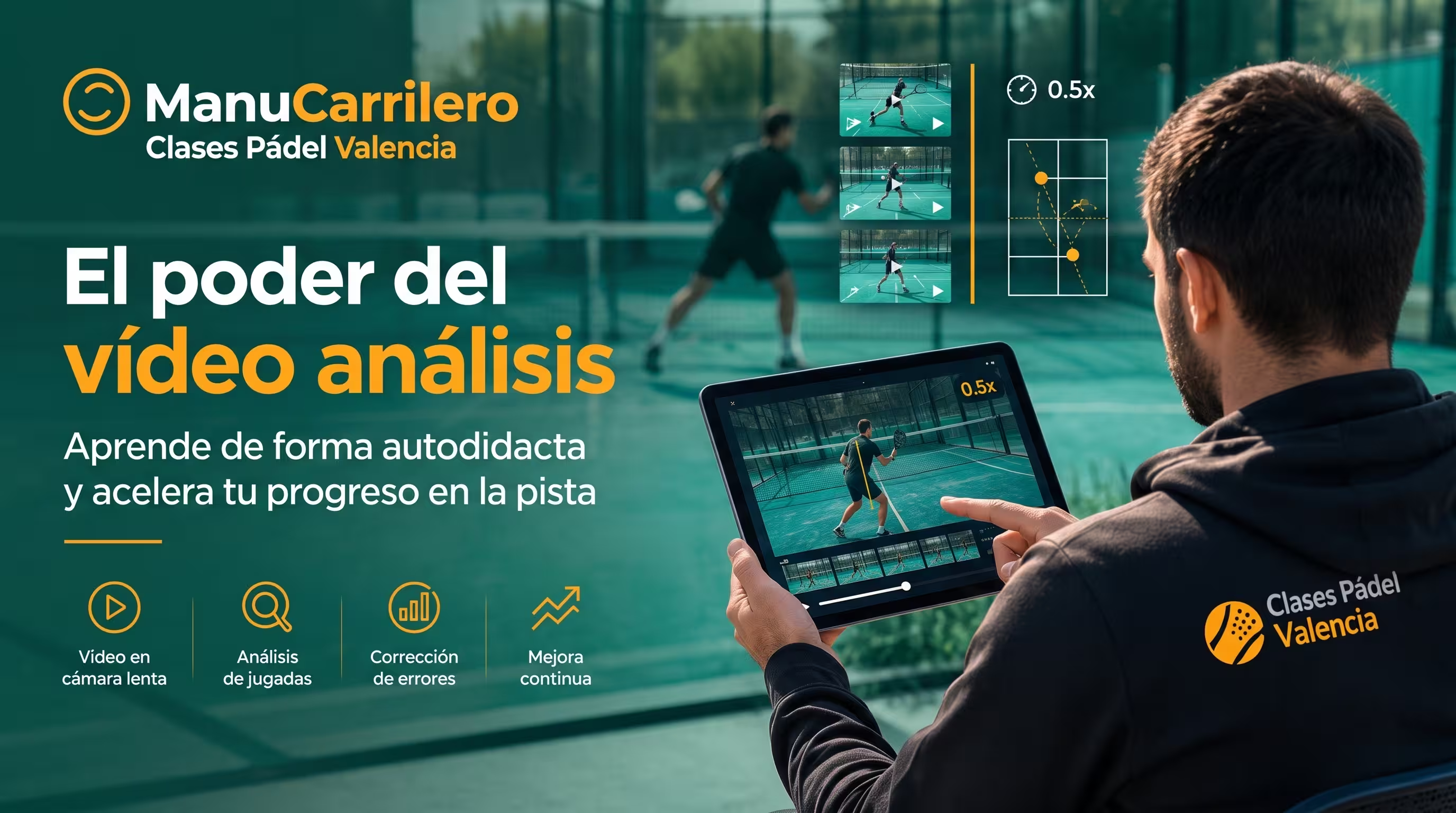
There is a sentence I hear every single week on the court: «Manu, I could swear I was bending my knees and getting the racket up early!». And they genuinely mean it: their brain swears their execution was textbook. Yet, when they look at the screen in slow motion for just ten seconds, reality hits hard: their legs were completely stiff, their elbow was cramped, and contact happened two feet behind their body.
That gap isn't a lack of effort or athleticism; it's called proprioceptive dissonance. What you think your body is doing rarely matches mechanical reality when your heart rate hits 140 bpm. If there is one tool that transformed my playing career and now drives my padel lessons in Valencia and Paterna, it is structured video analysis.
2006: Concrete courts, zip ties, and low-res footage
To understand why I rely so heavily on this technology, we have to travel back to 2006 and 2007. Back then, padel in Spain was nothing like today's professionalized industry; academies were virtually nonexistent, and most coaches were former tennis players teaching tennis habits against the glass. In fact, I obtained my official padel coaching credentials largely as a self-taught player.
While studying for my University Degree in Physical Activity and Sports Sciences (BSc CAFYD) and having qualified as a national tennis coach, I had no dedicated padel mentor on court. My entire learning process relied on reading technical blogs and, above all, filming myself obsessively in every single practice.
"We played on old concrete wall courts where suction cups were useless. I had to climb the wall, grip the upper wire mesh, and secure a GoPro 2 using zip ties and wooden sticks just to get a bird's-eye view. When I compared my unlisted YouTube videos side-by-side with Bela, Juan Martín Díaz, Lamperti, or Mieres, I saw how flawed my mechanics truly were." — Manu Carrilero, Sports Science Graduate
I still store dozens of gigabytes of hidden YouTube videos from those years. Watching Lamperti's shoulder rotation or Bela's delayed racket set-up off the back glass frame-by-frame forced me to rebuild my technique from the ground up. I didn't learn through trial and error; I learned through visual contrast.
The gap between perception and biomechanical reality
In sports motor learning, proprioception is the internal neural map that tells your brain where your limbs are positioned in space. When you repeat a technical mistake —such as snapping the wrist during volleys or hitting flat-footed— your nervous system forms a motor pattern that interprets that mistake as natural and comfortable. As we explore in our guide on why traditional padel coaching leads to stagnation, without objective visual proof, you can easily spend ten years repeating the exact same errors without knowing it.
From self-taught to Sports Science: The neuroscience of video feedback
During my sports science degree, I uncovered the physiological foundation behind what I had experienced on court: visual knowledge of performance (KP) feedback activates mirror neurons and visual-motor networks in ways verbal commands simply cannot match.
Why verbal cues fail under pressure
When an instructor yells from across the net «Close the racket face!» or «Watch your grip!», the player tries to comply, but lacks a physical visual reference. They assume they changed their hand angle, when in reality they barely shifted it 2 degrees away from common continental grip mistakes. But the moment you show them frozen slow-motion footage, an immediate cognitive click occurs: the brain comprehends the error instantly, lowering subconscious resistance to technical change.
How we use video analysis on court at Elite 22 (Paterna)
That exact approach forms the foundation of our coaching. Inside our covered indoor courts at Elite 22 (Paterna, Valencia), we film at least two full sessions per month for every squad, and encourage our players to record match play for tactical review.
Live slow motion: Fixing mistakes in 10 seconds
We never waste 20 minutes sitting around a monitor. It is surgical: if a student struggles with their back-glass attack, I bring out the tablet, record 3 continuous repetitions at 120/240 fps, and review it with them on court in under 10 seconds. The second the player exclaims: «I had no idea I was breaking my wrist and striking behind my hip!», the teaching breakthrough is achieved. From that moment on, their nervous system understands what needs adjusting.
The ultimate formula: Video feedback + professional ball machine
A major flaw in traditional lessons is delivering random manual feeds after a correction. In our group and pair coaching formats, we combine two key technological tools:
- Visual Diagnosis: Precise biomechanical identification using immediate slow-motion video feedback.
- Variables-Free Repetition: We calibrate our professional ball machine to deliver identical height, spin, speed, and cadence, allowing the player to groove the corrected motion without human feeding error.
My Gear Recommendations: How to Film Your Matches Hassle-Free
You no longer need to zip-tie action cams to high fencing like I did 20 years ago. To film your matches in Valencia or at your local club, start with your smartphone on ultra-wide (0.5x), or step up to an action camera like the Insta360 X4 (my go-to 360 camera on court for full coverage without blind spots). Here are the two field-tested accessories I recommend to all my students:
JYX Dedicated Padel Phone & Action Camera Mount
The go-to purpose-built solution across the amateur circuit. Designed with secure hooks for wire mesh and glass frames, it mounts smartphones and action cams via its standard thread.
Universal 1/4" Thread Mount for Cameras & Mobile
The industry-standard 1/4" screw mount I use to attach my Insta360 X4, GoPro, or magnetic clamp onto small articulated arms on side court pillars or metal plates.
Court Mounting Tips from Manu Carrilero:
- Diagonal baseline perspective: Mount your device on the rear glass wall, angled slightly toward the first corner panel or metal joiner plate. You will see all 4 players and ball depth clearly.
- Net post angle: To assess your bandeja prep or volley biomechanics head-on, use a magnetic clamp with an articulated arm on the side net pillar outside the court.
When Video Uncovers Physical Limits: Technique Meets Strength
When reviewing slow-motion match video with students, many technical breakdowns (such as lunging late or failing to get under low wall rebounds) stem directly from insufficient lower-body strength or poor thoracic rotation. Technique is refined on court, but the capacity to hold athletic positions is built in the gym.
If your footage shows a lack of explosiveness or you finish matches with lower back and knee soreness, check out the specialized conditioning protocols at Tu Entrenador regarding strength training and injury rehab for padel athletes.
View athletic conditioning on TuEntrenador.me