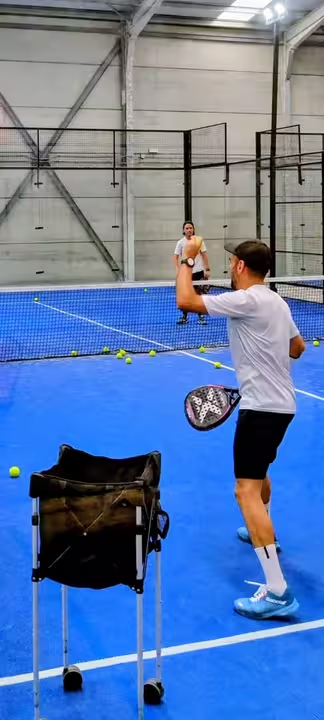
If you're reading this, you probably fit a profile I see daily on the courts: you've been playing for 1 to 5 years, you love competing with your friends a couple of times a week, but you feel constant frustration because your level has stagnated. You see others progressing faster and, worse, you start living with aches in your elbow, shoulder, or knee that just won't go away.
Hi, I'm Manu. I've been playing padel since 2007 and, as a Sports Science Graduate, my mission is clear: to ensure you have more power and suffer fewer injuries. And today, as your padel coach in Valencia, I want to talk to you about a fundamental strategic change that is revolutionizing the way we teach overhead shots.
If you play on the backhand side like me, you know that the aerial game is your main weapon. However, there is a hidden bad habit in classic padel teaching that is stealing your explosiveness and, in the long run, punishing your joints. Let's break it down.
The Historical Mistake: The Poisoned Legacy of Tennis
To understand why you can't hit it out by three with ease or why your vibora looks like a weak slice without weight, we have to travel back in time a bit. Padel has evolved brutally, but pedagogy has been slow to catch up with modern technique.
"When I started in padel, based on the fact that there were practically no padel coaches, everyone came from tennis and taught it that way. I'm talking about 2006 in Spain. There were some Argentines who taught well, but most were tennis teachers." — Manu Carrilero
Historically, in Spain and around the world, the first aerial shot taught was the classic bandeja. It was presented with a specific grip and body positioning that, if we analyze it biomechanically today, is very far from the preparation required for a good smash.
The problem is that many players have been trapped in that old teaching. They use patches like knee braces, heat sprays, or muscle rubs mid-match just to endure the pain caused by repeated poor execution over the years. Technique matters, of course, but your ability to execute it efficiently decides how much you can play without breaking down.
Biomechanics of Disaster: Why does the classic bandeja limit your power?
If you are one of those who notice a lack of explosiveness in your shots and you get tired before finishing matches, pay close attention to what happens with your arm in the traditional preparation of the bandeja.
"The problem with the traditional bandeja is that because of the way we position the arm and the hand, especially the wrist bent backwards with dorsal flexion, when you try to transfer that acceleration, the wrist is late. It can no longer get in front, like when we win an arm wrestle, to apply the force that topspin smashes require." — Manu Carrilero
That "wrist bent backwards" (dorsal flexion) is a trap. Being late, the impact absorbs excessive vibration that transfers directly to your elbow and shoulder. This is where the famous epicondylitis (tennis elbow) is born.
You must understand something fundamental about your body: the pain you feel in your arm or back is your brain's protection mechanism against potential damage. Your central nervous system turns on the pain alarm so you stop. You don't need more pills; you need to adapt your technique.
The New School: The "Triple Threat" of Padel
Today, the trend among the best coaches is to unify the preparation for the aerial shot. Instead of teaching you three different preparations that drive your brain crazy and warn your opponent of what you are going to do, we look for absolute efficiency.
"I see a certain analogy with the 'triple threat' in basketball. One way of holding the ball allows you to pass, dribble, or shoot without the defender knowing, because the preparation is the same." — Manu Carrilero
How do we apply this on the court? Very simple. We teach a base preparation of a topspin smash. It consists of raising the arm, tensing the bicep (as if you were showing off your muscles), and placing the racket behind the head.
From this single starting point, we hide our intentions from the opponent and open up a complete technical range:
- A pure topspin smash (to bring the ball back to your court, hit it out by three, or execute the 'rulo').
- An aggressive, heavy vibora.
- A modified, containment bandeja.
By placing the racket behind the head with a high elbow, the muscles of your shoulder and your scapular area work in a much more natural range of motion, radically reducing the risk of joint injury during impact.
Invest in your Long-Term Performance
Many amateur players feel they don't have time or fear that changing their technique at this point will make them play worse in the short term. It's normal to doubt, but the easy path is rarely the right one.
"If I teach you a bandeja, in the long run it will be very hard for you to learn the topspin smash. On the other hand, if I teach you the preparation traditionally associated with the vibora, I can always teach you how to hit a bandeja later. It's a change that allows for more improvement in the long term." — Manu Carrilero
If I teach you to prepare from minute one as if you were going to hit a topspin smash, I am building a powerful movement pattern in you. Later, "lowering the revs" on that gesture to execute a safe bandeja is a natural process. The other way around is almost impossible.