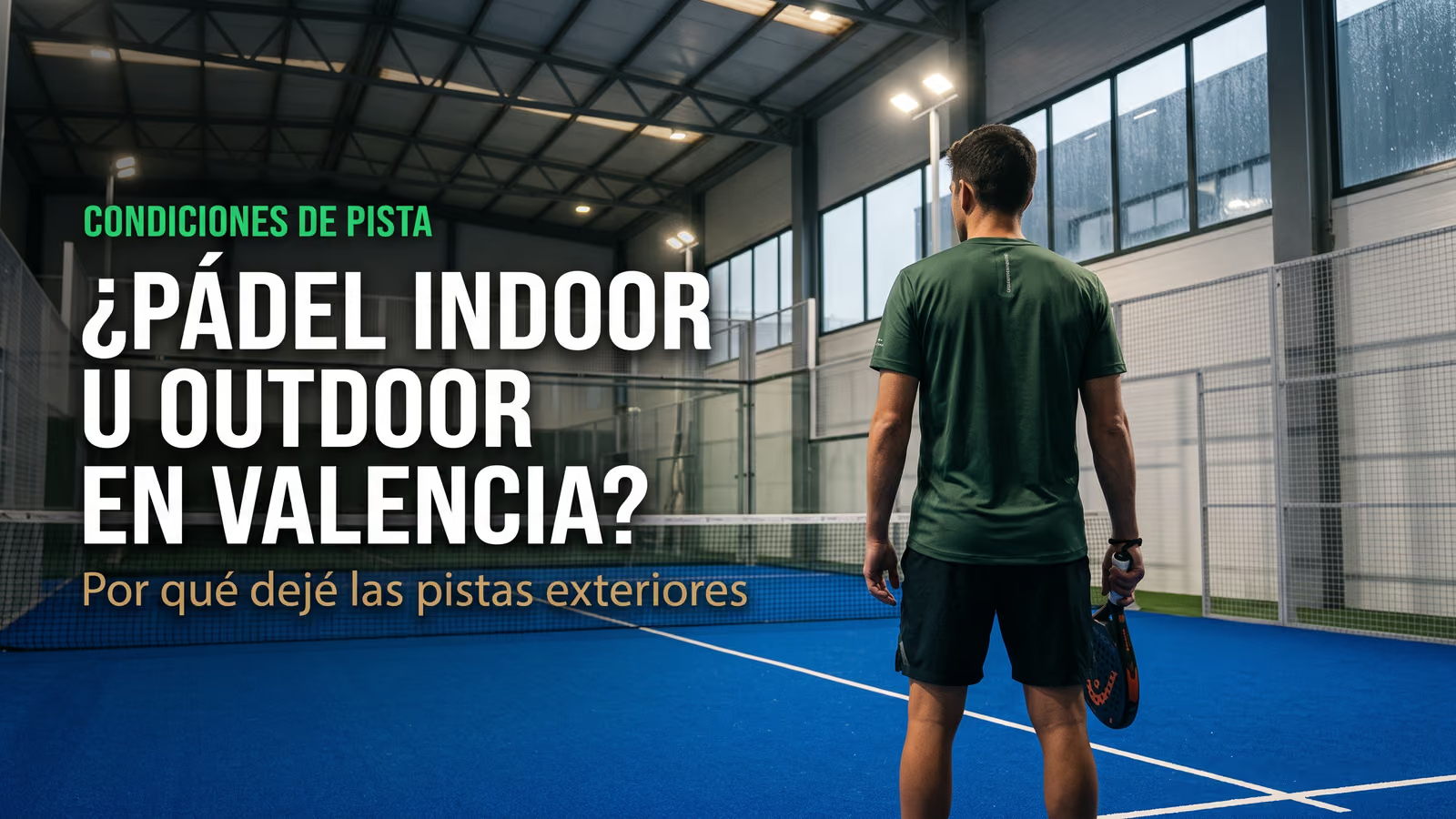
There is an inconvenient truth about padel that commercial sports brochures rarely mention: on an open outdoor court, neither technical progress nor training consistency can be guaranteed. In Valencia, a city blessed by sun but challenged by coastal humidity, strong westerly winds, and sudden seasonal storms, this reality is absolute.
Many students ask why I conduct 100% of my coaching undercover and why, for nearly eight years of my sports career, I preferred not to teach padel rather than place a student on an outdoor court. Here is the true coaching story, the biomechanics, and the physics behind that standard.
The 2013 Lesson: Living at the Mercy of Weather Forecasts
I earned my official padel coach certification back in 2013. At that time, virtually every padel facility across Valencia was built outdoors. I began teaching with great enthusiasm, only to run head-first into a recurring logistical headache.
At 4:30 PM, dark clouds would roll over the mountains, drop five minutes of light rain, and instantly ruin an entire evening of booked sessions. It was not just the rainfall during the lesson; it was the disruption before and after.
Prior Rain and the Squeegee Myth: Why Wet Padel is Not Tennis
Players coming from tennis often assume that once rain stops and maintenance runs foam rollers over surface puddles, the court is ready for play. In tennis that works because you compete on clay or open hard courts without walls. In padel, squeegeeing the turf solves very little.
The artificial turf fibers hold moisture, soaking balls immediately. They gain heavy water weight and spray water into your eyes on impact. But the real structural problem is not the turf: it is the glass walls.
"Wet or damp glass has zero friction: balls do not rebound upward, they slide straight down like soap. Playing padel on wet glass is not padel; it becomes something else, closer to pickleball, completely detached from the tactical essence of the game." — Manu Carrilero, Sports Science Graduate (CAFYD) & Padel Coach
Practicing back-wall defence, double-wall reads, or attacking wall exits becomes entirely pointless. The ball drops dead or skids with unpredictable trajectories, instilling bad technical habits that derail natural motor development.
Student Frustration and Coaching Deadlock: The 2017-2024 Hiatus
This weather instability caused a double setback:
- For the student: it broke their consistency and progression. When you commit to weekly padel lessons, you are not simply buying ball feeds: you are buying mental escape, athletic health, and structured leisure. It is your sacred weekly window. When a session is cancelled at the last minute, your evening plan collapses, you miss out on sport, and you lose accumulated training momentum.
- For me as a professional: it prevented me from running a stable, high-standard sports academy. Surviving on cancellations, attempting awkward weekend make-ups, or charging clients for compromised sessions on wet glass went against my professional ethics.
That exact reason is why between 2017 and late 2024, I stopped offering padel coaching. I declined outdoor facilities and focused entirely on private athletic conditioning and personal training through Tu Entrenador.
So what did I do while I was not coaching padel?
During those years I focused entirely on strength, conditioning and injury rehabilitation. If that side of performance interests you, all of my technical content is published on Tu Entrenador, my personal training and athletic conditioning project.
Visit TuEntrenador.me blogOnly when I secured a permanent base at a 100% indoor club like Elite 22 in Paterna did I resume padel coaching with full confidence.
The Rise of Indoor Padel in Valencia: From the 2008 Crisis to Warehouses
To understand why Valencia took time to establish covered venues, we must look back at the 2008-2012 financial crisis. When I began competing in 2007, almost all regional padel was concentrated in traditional tennis clubs on uncovered outdoor courts.
When the 2008 economic crisis hit, many commercial companies closed, leaving extensive industrial warehouses vacant across metropolitan business parks (such as Fuente del Jarro in Paterna, Vara de Quart, or Beniparrell). Those empty, high-ceiling spaces crossed paths with an explosive grassroots demand for padel: entrepreneurs recognised that industrial buildings were ideal for indoor conversion. That transition created modern covered padel in Valencia, which we review thoroughly in our guide on the best indoor padel clubs in Valencia.
3 Weather Factors That Disrupt Outdoor Technique
1. Soapy Glass and Mediterranean Night Humidity
In Valencia, relative humidity surges as soon as daylight fades. From 7:30 PM onward in autumn and winter, or during damp early mornings, exterior glass walls condense moisture without any rain. Glass surfaces get completely soaked, causing back-wall rebounds to slide dead off the glass. Players develop wall anxiety, stop bending their knees, and adopt poor technical compensation patterns that take months to unlearn.
2. Gusty Winds: The Disruptor of the Kinetic Chain
Westerly winds deflect ball trajectories in the final meter before contact. As explored in our clinical guide on padel biomechanics and elbow injuries, padel requires clean power transfer from the legs through to the wrist. Sudden wind gusts force the player to stop their body rotation and flick their wrist awkwardly to rescue contact, triggering severe forearm strain.
3. Temperature Extremes: From Summer Heat to Winter Warm-ups
Under scorching July sun, open courts present direct heat exhaustion risks, while cheap canvas canopies create an oppressive greenhouse effect. In contrast, a solid warehouse with natural cross-ventilation like Elite 22 keeps air circulating steadily: it is warm in summer, but playable; and in winter it protects you from freezing drafts, allowing you to warm up properly and play comfortably after shedding light layers.
Training at Elite 22: Protecting Your Weekly Routine
I established my coaching headquarters at Elite 22 in Paterna's Fuente del Jarro industrial area (under 10 minutes from Valencia centre, La Eliana, Burjassot, Bétera, Godella, and San Antonio de Benagéber) for one decisive reason: it is a solid, high-ceiling warehouse featuring steady natural cross-ventilation.
Here, we never have to monitor weather radars. You know precisely when you train, assured that every minute on court focuses on technical refinement, automated repetition with the ball machine, and slow-motion video analysis.
- Small squads (3 to 5 players): €69/month per person with indoor court hire fully included.
- Pairs: €95/month per person.
- Private 1-on-1: €165/month.
If you want the full breakdown of every format and rate, it is detailed in how much padel lessons cost in Valencia and in our comparison of group vs. pair vs. private lessons.
Frequently Asked Questions About Indoor and Outdoor Padel in Valencia
Why can't you play padel on a wet outdoor court even if the rain has stopped?
What happens to outdoor padel lessons in Valencia during bad weather?
Does it get too hot inside an indoor padel club during Valencia summers?
Tired of Weather Cancellations Disrupting Your Padel Routine?
If you are looking for padel lessons in Valencia and what you really want is to actually progress, with a guaranteed court every single week and no weather radar anxiety, you can find my full methodology on my padel lessons in Valencia page. Secure your weekly indoor spot at Elite 22 (Paterna) and train with professional sports science methodology, automated ball machine repetition, and slow-motion video analysis.