
There is a scene that repeats itself every season on the courts: a player walks in with a good athletic build, a tennis racket in the bag and a question on his face. "Manu, can you play padel well if you come from tennis?" And the short answer is yes, but with nuances. Very important nuances.
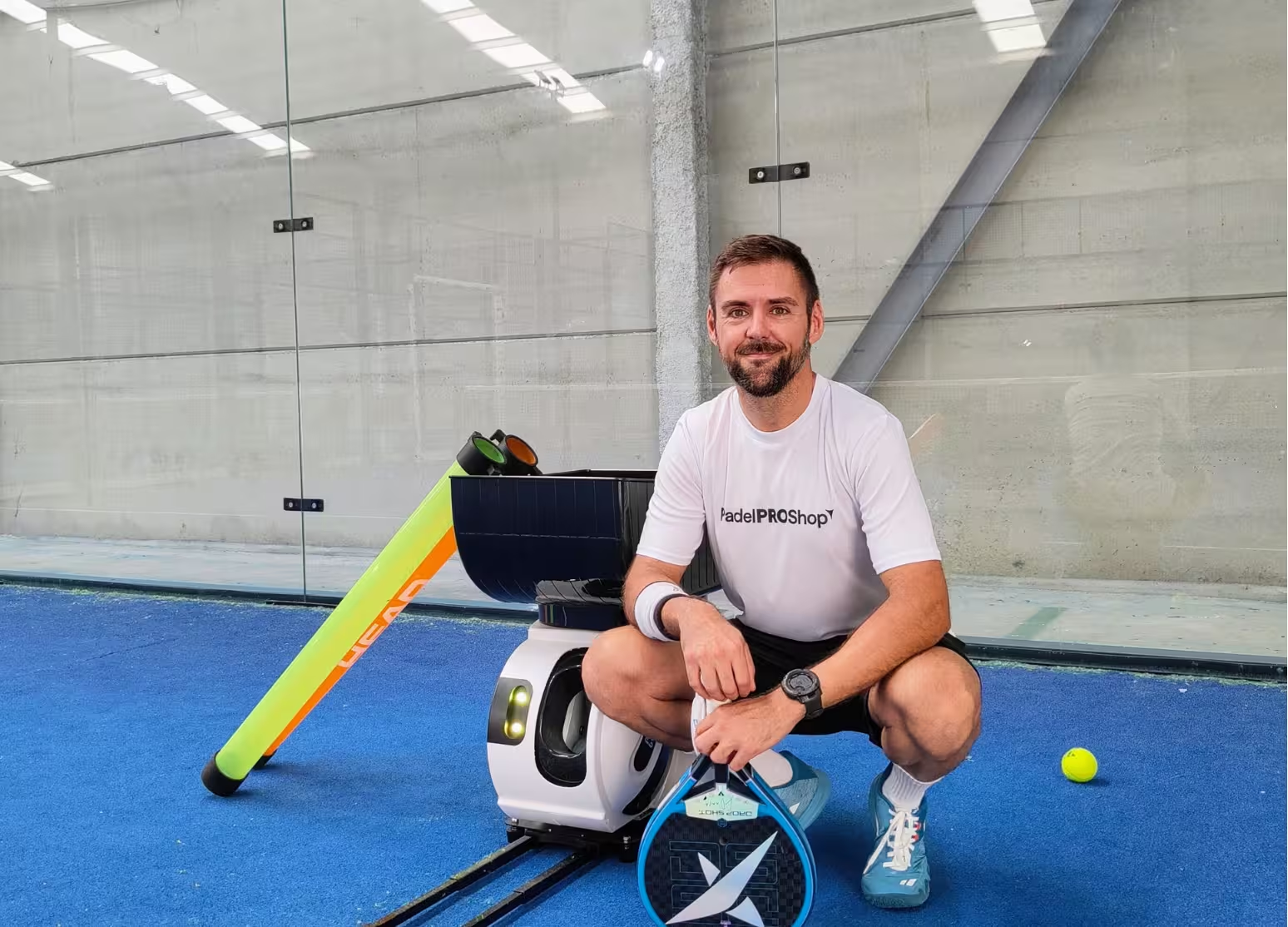
I'm Manu Carrilero, a Sports Science graduate and padel coach. I have been in this since 2007 and I have seen three types of student: the one who starts from scratch, the self-taught one who has already picked up bad habits, and the one who comes from another racket sport. Today I want to focus on the third one, because he is the one with the most wasted potential.
When someone arrives without ever having held a padel racket, I have a blank canvas. It will be harder at the beginning, but he learns well from minute one. When a self-taught player arrives, things get complicated: we have to unlearn. But when a tennis player arrives, there is a huge opportunity, because he brings good things that, properly channelled, will save him months.
What positive transfer is (and why racket sports get along so well)
In sports science we call transfer the effect that learning one skill has on another. When that effect adds up, we talk about positive transfer: what you already know helps you learn the new thing. When it subtracts, we talk about negative transfer: an automatic movement that gets you into trouble.
Racket sports are the perfect example of positive transfer. They share something very deep: reading the ball, reaction time, hand-eye coordination and the ability to hit while moving. That is why a good table tennis player tends to survive on a padel court from day one, and why a badminton player understands immediately where to position himself.
"The first time I played pickleball was in Thailand, at a club where people played a lot. The next day I was at the top of that club's players. It wasn't magic: I came from padel, table tennis, tennis, badminton, squash and fronton. All of that transfers." — Manu Carrilero
Now the other side. Transfer can also work against you. I have a friend who, when he moved from tennis to padel, tried to play his half-volley shots inside the padel court. That movement, which is a virtue in tennis, limited his learning in padel because it stopped him from reading the wall and forced him to hit on the same plane every time. However, his overhead smashes were clearly better than anyone else's in our group. The same person, two opposite transfers: one that adds and one that subtracts.
The key is knowing what to use and what to park. Let's get into it.
What tennis gives you: the shots you already have
The smash: your tennis serve is the best gift
If you are a good tennis player with a good overhead serve, you already have 70% of the work done. Think about it for a second: a tennis serve is, biomechanically, a topspin smash. Same movement chain, same leg drive, same shoulder rotation, same pronation. The only thing that changes is the context: in padel there is no run-up, no previous bounce and the ball arrives higher and closer to the wall.
That means you can build your whole overhead game on a base you already master:
- The rulo to the back glass, to send the ball out through the wall and recover position.
- The smash out through the three-metre gap, to attack without gifting the ball.
- The smash out through the four-metre gap, when the ball sits comfortably and you want to close the point.
- The topspin smash that brings the ball back into your court, the control resource almost nobody masters.
What you do have to adjust is the contact height and the intention. In tennis you serve so the ball bounces and travels; in padel you smash so the ball goes down, climbs the wall or stays short. The movement is yours; the direction is your decision.
The volley and the groundstrokes: a head start
Tennis volleys transfer almost directly. You have hands, you have the block, you have that short movement in front of your body that is pure gold at the padel net. And the groundstrokes, both forehand and backhand, also come as standard: you have the timing, the eye and the ability to hit with the racket in front.
The problem is not the shot. The problem is how you use it. And that takes us to the next point, the one that tennis players find hardest.
What you have to "shrink": position, preparation and power
Less sideways, less preparation, less travel
In tennis we set the body very open and very sideways, with the racket far back, because the movement needs travel to generate speed. Not in padel. In padel we stand more square to the net, with a short preparation and the racket close to the body. Not because we are worse, but because the space is smaller and the time is shorter.
If you come from tennis, your brain will automatically ask for that long preparation. And that preparation, on a 20x10 court, translates into arriving late. The ball passes you, or you hit in a forced position, or you end up in the wall. The solution is to reduce the movement until it feels "too little": small preparation, elbow close, racket in front of the body at impact.
From the explosive squat to permanent control
In tennis you load the legs like a spring: you go down, you coil and you push forward and up to project the shot. It is an explosive squat. In padel, on the other hand, you stay low the whole time. There is not so much jumping or projection; there is base, balance and control.
And then there is power. In tennis, hitting hard from the baseline wins points. In padel, hitting hard from the baseline gifts points. The ball flies out, hits the glass and comes back. Padel is not won with speed; it is won with time, height and placement. Look for flat balls with control, and save the power for the right moment.
The three mistakes that will hold you back
Mistake 1: playing glued to the glass
The glass is your friend, not your enemy. If you try to play tennis inside a padel court, you will end up cornered against the wall, watching the ball go past you. No matter how good you are, if you don't apply this, you won't be able to use your game.
In padel you have to learn to use the wall: to wait, to let the ball come, to step out of it with space. Tennis players tend to attack the ball too early and too close to the glass. Padel players know that sometimes the best play is to let the ball pass and hit with margin.
Mistake 2: the tennis hitting speed
In tennis, a hard shot from the baseline is a weapon. In padel, the court is shorter and the ball has less distance to travel. If you hit with the intensity of a tennis forehand, the ball will most likely fly to the glass, or you will give the opponent time to reach it after the wall and play comfortably.
You cannot win with speed. You have to win with height, placement and patience. That is the big lesson tennis players take longest to accept.
Mistake 3: heavy topspin
In tennis, topspin makes the ball run, and that benefits you because the opponent cannot reach it. In padel, the ball runs, hits the glass and, because of the topspin, climbs the wall. In other words: the ball climbs, goes up and stays high, comfortable and attackable for your opponent. The exact opposite of what you want.
So, if you come from tennis, avoid heavy topspin as your main resource. Use height to defend and a flat ball to attack, but do not turn the wall into a staircase.
Summary for your first week in padel
- Use your tennis smash and volley, but shorten the movement.
- Stand more square to the net and stay low the whole time.
- Hit flat and with control; power comes at the end.
- Let the ball reach the glass before you hit it.
"Does one hold the other back?" Tennis and padel feed each other
This week a student asked me exactly that. She has been playing tennis with a coach for a few years and is now learning padel too. She is going to combine both sports and her fear was logical: "Manu, won't one hold the other back?"
The answer is no. Playing tennis will make you better at padel, and playing padel will make you better at tennis. The reason is that positive transfer we talked about: ball reading, timing, coordination and the mechanics of overhead shots are trained in both sports. The only thing you need is a clear head to get the most out of each one.
That said, you have to be aware of which context you are playing. You cannot apply the tennis position in padel or the padel height in tennis. But if you separate the two scenarios mentally, each one feeds the other. Tennis gives you power and reading; padel gives you control, patience and wall play.
How to make the transition with a clear plan
What works best on court is a three-phase approach. First, a diagnosis: watch how you hit, with slow-motion video, to identify which movements come from tennis and which ones need rewriting. Second, a progression with a ball machine: first without walls, then with walls, then in match situations. Third, a lot of conscious repetition, because your body has to automate a shorter version of what it already knows.
If you want to start with the basics, I have a padel beginners guide that will organise your first steps. And if you come from tennis, your first adjustment will probably be the grip: I recommend reading my article about the continental grip and its mistakes before you automate anything.
You may also want to understand how to protect your arm during this transition. Changing movement and load has a cost, and in my article about padel elbow injuries and biomechanics I explain where the stress happens and how to avoid it.
In my padel lessons in Valencia I work on exactly this: making the most of what you already bring and correcting what holds you back. If you prefer to start in a group, take a look at the available class formats.
Conclusion: you are not starting from zero, you are starting with an advantage
Moving from tennis to padel is not starting over. It is reusing a great base and adapting it to a smaller space, with walls and with a different intention. Use the smash, the volley and the groundstrokes. Shrink the position, the preparation and the power. And avoid the three mistakes that will send the ball back into your face: the glass, the speed and the topspin.
If you do it in order, in a few weeks you will be playing with judgement. And the best part: your tennis will improve too. Because racket sports, when trained with a clear head, speak to each other.