I have always been an early adopter in nearly every aspect of my life. I genuinely enjoy testing new tools before they hit mainstream adoption. Being among the first often demands extra upfront time to think through workflows, test configurations, and troubleshoot; but in the medium and long term, it enables far more consistent results and sets a higher standard of coaching.
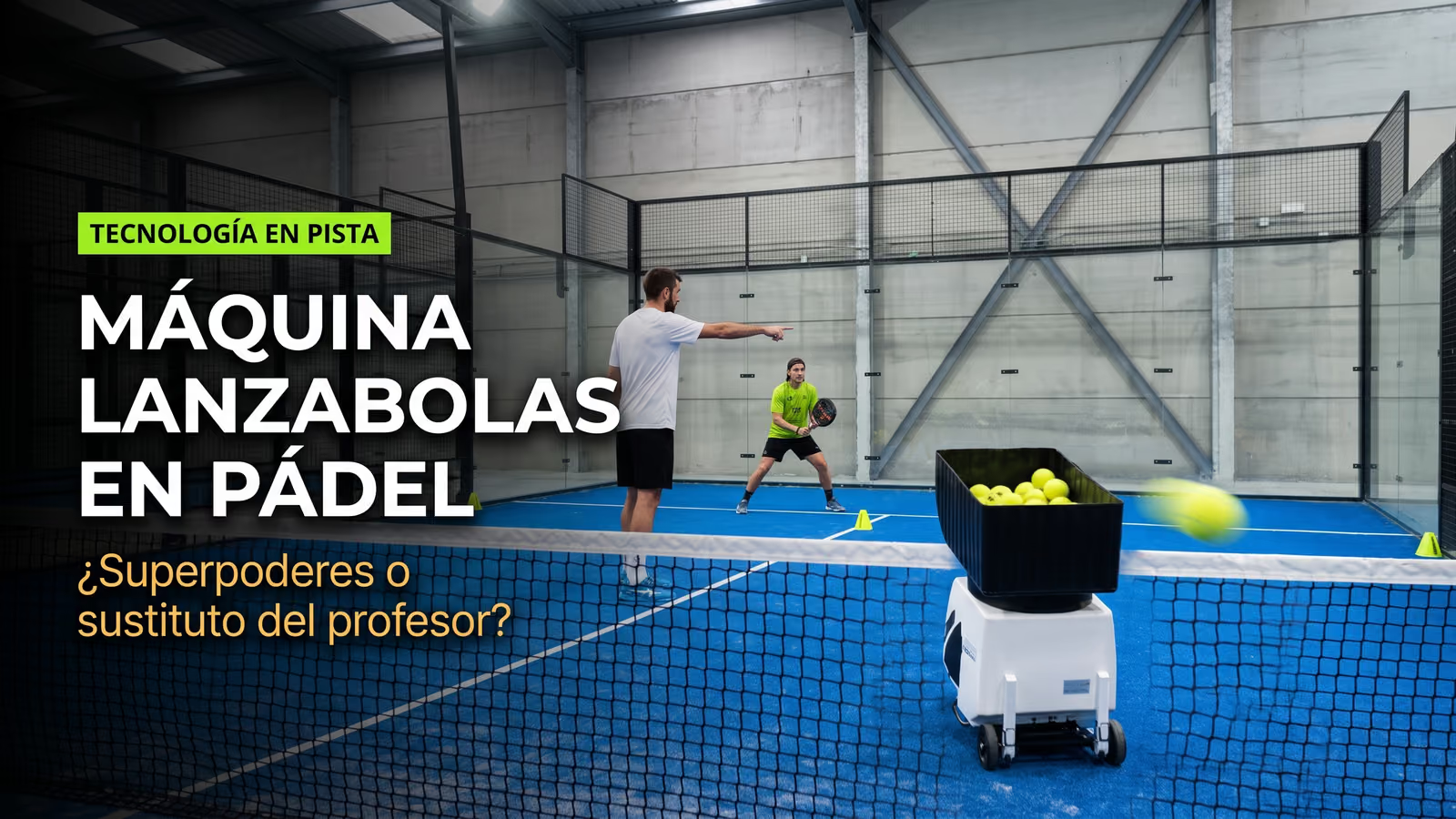
That is exactly what happened when I integrated a professional ball machine into my regular coaching sessions at the Elite 22 indoor club in Paterna (Valencia).
There is still considerable hesitation —and quite a few misconceptions among traditional instructors— surrounding ball machines. Here is my honest assessment of where this technology stands today, why it grants me genuine "superpowers" on court, and what its real strengths, limitations, and costs are.
The Robot Vacuum Analogy: Where Does the Technology Stand?
Whenever players or colleagues ask for my opinion on padel ball machines, I always use the exact same comparison: they are at the same evolutionary stage household robot vacuums went through.
Stage One (2–3 years ago)
Early machines were essentially "blind". They lacked mobile apps, relied on crude mechanical dials, and could not reliably string together varied drills.
Stage Two (the present)
This is where high-end models like the Pongbot Pace Pro sit today. They feature smartphone connectivity and allow custom spins, speeds, and heights, yet they still require manual positioning and cannot autonomously map court obstacles.
Stage Three (the near future)
Think of top-tier robot vacuums today (like the Roborock I use at home, which cleans specific rooms via voice commands, monitors its own filter life, and maps obstacles with laser precision). Padel robots have not reached full autonomous mobility yet, but they inevitably will.
Does that mean current machines are premature? Not at all. When paired with sound sports pedagogy, they represent a monumental training upgrade.
Why the Ball Machine Grants Me "Superpowers" as a Coach
Many coaches ask whether a machine is genuinely superior to the traditional ball basket. My perspective is simple: the machine does not replace me; it liberates me.
1. Close-up Feedback Without Shouting Across the Net
In traditional padel lessons, the instructor spends most of the hour 15 to 20 meters away on the opposite side of the net, feeding balls from a basket. This creates three chronic issues: the coach must shout across the court over ambient noise to offer pointers, or they constantly halt the drill to walk around the net and explain a detail, or —most commonly— they stop correcting altogether and simply empty the basket without technical input.
With the machine, that friction disappears. The unit delivers exact, repeatable trajectories, while I stand three feet away from my student, watching foot placement, elbow height, and wrist relaxation to provide quiet, immediate feedback in real time. It is the same advantage I chase with slow-motion video analysis: removing the noise so the player understands the exact adjustment.
2. Identical Coach Demonstrations: "Watch My Feet"
Demonstrating correct biomechanics during live play can be tricky. If you have an advanced student, you might ask them to feed you a specific ball, but amateur players rarely deliver the precise pace or angle required for a clean demonstration.
"Just yesterday during a squad session, students felt rushed on defense, insisting the ball was arriving too fast to set up. I told them: «Watch my feet». I stepped into their exact position, the machine delivered the identical ball at the identical speed, and I executed a compact block with zero rush, marking the sweet spot on the turf. They immediately replicated it on the next rep." — Manu Carrilero, Sports Science Graduate
Group Dynamics: Continuous Flow and Fatigue Management
A common error when using automated technology is assuming that because a machine can fire balls indefinitely for 60 minutes, players should hit non-stop. That approach is counter-productive: it triggers neuromuscular fatigue, compromises mechanics, and leads to boredom.
Drawing from my Sports Science (CAFYD) background, I structure sessions with athletic precision:
- Time-Capped Work Blocks: Rather than guessing how many balls remain in a basket, we work in clean 1-, 2-, or 3-minute sets depending on squad size. Players maintain peak mental focus and stop before mechanical breakdown occurs.
- Active Ball Recovery Circuits: In my squads of 3 to 5 players, while one player executes a technical sequence (such as a back-wall exit into a transition volley), the player rotating off collects 5 to 10 balls and returns them to the machine hopper. The drill never stalls and session tempo stays high.
To see how high-volume repetition complements live game situations, explore our breakdown on padel lesson formats (group, pair or private).
Threat or Asset? The Coach's Perspective
In amateur clubs, many instructors view automated technology with suspicion, fearing it might make their role obsolete.
My view is straightforward: if you perceive yourself merely as a ball feeder, a ball-feeding machine is indeed a threat. But if your primary value lies in biomechanical analysis, kinetic chain optimization, real-time feedback, and tactical mentoring, the machine is not a rival: it is the single most valuable teaching asset you can employ on court. That is the same philosophy behind my padel lessons in Valencia and Paterna.
Honest Drawbacks and Hardware Limitations
To maintain complete transparency, the hardware has notable constraints you should consider:
- Learning Curve & App Setup: Programming tailored combinations requires initial study and patience. Switching drills between players can feel slightly sluggish on your phone screen if presets are not prepared beforehand.
- Static Court Placement: Most current commercial units remain stationary during play. While motorized prototypes capable of dynamic court traversal are currently being tested, today's machines feed from a fixed position.
- Financial Investment: A dependable padel ball machine with app connectivity and legitimate battery runtime ranges from €1,000 to €1,500 for entry-level units, climbing up to €4,000 to €6,000 for commercial multiaxis models. It is a substantial capital expense that only justifies itself through daily professional coaching.
Want your own ball machine? My recommendation
If this article has convinced you to make the leap, here are the two routes I recommend. My first pick —for fast shipping, warranty and hassle-free returns— is Amazon. As a second option, the official Pongbot store, where you can apply a discount coupon.
Padel ball machine on Amazon
Fast delivery, warranty and easy returns. The simplest way to start training with a machine.
Pongbot Store with EPICPADEL5
Buy direct from the manufacturer and apply coupon EPICPADEL5 for a discount.
Note: these are affiliate links. If you buy through them I may earn a small commission, at no extra cost to you.
When Technique Is Fine but the Body Isn't
A machine lets you repeat the correct motion hundreds of times in minutes. But if your lower body can't hold the position or you lack thoracic rotation, reps degrade and injuries creep in. Technique is trained on court; the motor capacity to sustain it is built in the gym.
If you want to match this on-court technical repetition with physical conditioning, visit the functional strength and injury-prevention guides published on Tu Entrenador: strength training and injury rehab for padel players.
View athletic conditioning on TuEntrenador.meThe machine in action: watch it on video
If you want to see how we put it into practice, under my brand Epic Padel VLC I have published two videos explaining it in first person:
The ball machine as a coach
How I use it to run a session: controlled repetition, close-up feedback and group dynamics without stopping the drill.
Watch on Instagram →The machine as an amateur player
The contrast: using it on your own, at your own pace, to train repetitions as long as you want without relying on anyone else.
Watch on Instagram →And remember: technique is automated on court, but the physical capacity that sustains it is built elsewhere. My brand Epic Padel VLC is linked to the physical training project Tu Entrenador, where you'll find the strength and injury-prevention programs that complement this machine work.